<?xml version="1.0" encoding="utf-8"?>
<feed version="0.3" xmlns="http://purl.org/atom/ns#" xmlns:dc="http://purl.org/dc/elements/1.1/" xml:lang="en">
<title>Rick Jacobus</title>
<link rel="alternate" type="text/html" href="http://www.rjacobus.com/resources/" />
<modified>2008-05-20T00:43:21Z</modified>
<tagline></tagline>
<id>tag:www.rjacobus.com,2008:/resources/5</id>
<generator url="http://www.movabletype.org/" version="3.16">Movable Type</generator>
<copyright>Copyright (c) 2008, Rick Jacobus</copyright>
<entry>
<title>Asset Building and Affordable Homeownership</title>
<link rel="alternate" type="text/html" href="http://www.rjacobus.com/resources/archives/homeownership/000632.html" />
<modified>2008-05-20T00:43:21Z</modified>
<issued>2008-03-04T23:24:10Z</issued>
<id>tag:www.rjacobus.com,2008:/resources/5.632</id>
<created>2008-03-04T23:24:10Z</created>
<summary type="text/plain">Homeownership has historically offered the best asset building strategy available to middle class american families.  But homeownership has changed and is no longer available to many moderate income households.  Local government programs that seek to make ownership affordable however frequently choose to limit the price that homeowners can sell for in order to preserve affordability for future buyers.  But affordability protections are sometimes opposed by those who want to encourage homeowner wealth building.  These debates are really about the very purpose of affordable homeownership programs.  This 15 minute video presentation looks more closely at local affordable homeownership programs from the point of view of asset building.   Can affordable ownership programs be seen as asset building strategies?  How do they compare with traditional ownership?</summary>
<author>
<name>Rick Jacobus</name>

<email>Rick@rjacobus.com</email>
</author>
<dc:subject>Homeownership</dc:subject>
<content type="text/html" mode="escaped" xml:lang="en" xml:base="http://www.rjacobus.com/resources/">
<![CDATA[<p>Homeownership has historically offered the best asset building strategy available to middle class american families.  But homeownership has changed and is no longer available to many moderate income households.  Local government programs that seek to make ownership affordable however frequently choose to limit the price that homeowners can sell for in order to preserve affordability for future buyers.  But affordability protections are sometimes opposed by those who want to encourage homeowner wealth building.  These debates are really about the very purpose of affordable homeownership programs.  This 15 minute video presentation looks more closely at local affordable homeownership programs from the point of view of asset building.   Can affordable ownership programs be seen as asset building strategies?  How do they compare with traditional ownership?</p>

<p><embed src="http://blip.tv/play/oXoBAA" type="application/x-shockwave-flash" width="490" height="367" allowscriptaccess="always" allowfullscreen="true"></embed></p>

<p>Embed this presentation in your website:<br />
<input name="Embedbox" type="text" value="&lt;embed src=&quot;http://blip.tv/play/AbDtSAA&quot; type=&quot;application/x-shockwave-flash&quot; width=&quot;720&quot; height=&quot;570&quot; allowscriptaccess=&quot;always&quot; allowfullscreen=&quot;true&quot;&gt;&lt;/embed&gt;" size="30" /></p>

<p>Learn more:</p>

<p><a href="http://www.rjacobus.com/resources/archives/papers/000425.html">Shared Equity Transformative Wealth</a><br />
<a href="http://www.rjacobus.com/resources/archives/portfolio/000444.html">Resale Formula Comparison Tool</a></p>]]>

</content>
</entry>
<entry>
<title>Wealth Creation and Affordability in Inclusionary Housing</title>
<link rel="alternate" type="text/html" href="http://www.rjacobus.com/resources/archives/workshops/000631.html" />
<modified>2007-11-03T05:49:19Z</modified>
<issued>2007-11-03T05:20:39Z</issued>
<id>tag:www.rjacobus.com,2007:/resources/5.631</id>
<created>2007-11-03T05:20:39Z</created>
<summary type="text/plain"> Inclusionary housing ordinances can produce vital community assets and valuable personal assets. Should the programs seek to preserve these community assets, or allow residents of the affordable units to reap the full rewards of homeownership?
This session examined various techniques for balancing these two important goals, including resale provisions that utilize
shared appreciation formulas and community land trusts.</summary>
<author>
<name>Rick Jacobus</name>

<email>Rick@rjacobus.com</email>
</author>
<dc:subject>Workshops</dc:subject>
<content type="text/html" mode="escaped" xml:lang="en" xml:base="http://www.rjacobus.com/resources/">
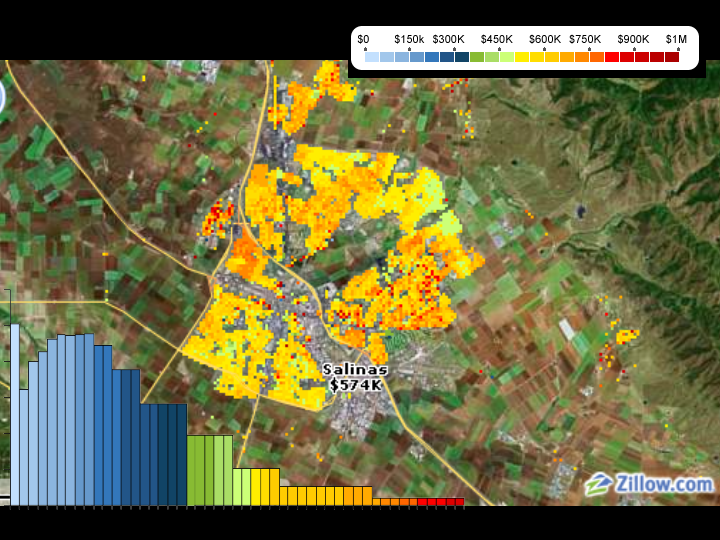
<![CDATA[<p><a href="http://www.rjacobus.com/resources/archives/Map1.png"><img alt="Map1.png" src="http://www.rjacobus.com/resources/archives/Map1.png" width="360" /></a></p>

<p><strong>Balancing Wealth Creation and Affordability</strong><br />
A workshop at the National Inclusionary Housing Conference<br />
October 31, 2007</p>

<p>Inclusionary housing ordinances can produce vital community assets and valuable personal assets. Should the programs seek<br />
to preserve these community assets, or allow residents of the affordable units to reap the full rewards of homeownership?<br />
This session examined various techniques for balancing these two important goals, including resale provisions that utilize<br />
shared appreciation formulas and community land trusts.</p>

<p>Moderator: Carla Robinson, Research Director, National Housing Institute, Montclair, New Jersey<br />
Rick Jacobus, Partner, Burlington Associates in Community<br />
Development, Oakland, CA<br />
Dev Goetschius, Executive Director, Housing Trust of Sonoma County, Petaluma, California<br />
Myrna Melgar, Director of Homeownership Programs, San Francisco Mayor's Office, San Francisco, California</p>

<p><img alt="Document Image" src="http://www.rjacobus.com/images/icons/resaletool_sm.gif" width="115" align="left" hspace="5" vspace="5" />Materials:<br />
<a href="http://www.rjacobus.com/resources/archives/portfolio/000444.html">Resale Formula Comparison Tool</a><br />
.<br />
.<br />
.<br />
.</p>

<p>Additional Resources:<br />
<a href="http://www.nhc.org/pdf/chp_se_strategies_0407.pdf">Preservation of Affordable Homeownership: A Continuum of Strategies </a></p>

<p><a href="http://www.rjacobus.com/resources/archives/papers/000425.html">Shared Equity, Transformative Wealth</a></p>

<p><br />
</p>]]>

</content>
</entry>
<entry>
<title>Best Practices in Administration and Oversight of Inclusionary Housing</title>
<link rel="alternate" type="text/html" href="http://www.rjacobus.com/resources/archives/papers/000630.html" />
<modified>2007-10-30T00:45:31Z</modified>
<issued>2007-10-30T00:26:03Z</issued>
<id>tag:www.rjacobus.com,2007:/resources/5.630</id>
<created>2007-10-30T00:26:03Z</created>
<summary type="text/plain">This paper outlines some of the challanges of ongoing administration of Inclusionary housing programs and highlights the policies, procedures and systems that successful programs have been using to address these challanges.  The paper identifies common approaches to staffing these programs over time including partnerships with local consultants or nonprofit organizations and looks at scalable revenue sources to support the ongoing costs of administration. </summary>
<author>
<name>Rick Jacobus</name>

<email>Rick@rjacobus.com</email>
</author>
<dc:subject>Papers</dc:subject>
<content type="text/html" mode="escaped" xml:lang="en" xml:base="http://www.rjacobus.com/resources/">
<![CDATA[<p><img alt="IZAdminCover_sm.jpg" src="http://www.rjacobus.com/resources/archives/IZAdminCover_sm.jpg" width="160" height="207" align="left" hspace="5" vspace="5" /><br />
<strong>Delivering on the Promise of Inclusionary Housing:</strong> <br />
Best Practices in Administration and Oversight<br />
By Rick Jacobus for PolicyLink</p>

<p>This paper outlines some of the challanges of ongoing administration of Inclusionary housing programs and highlights the policies, procedures and systems that successful programs have been using to address these challanges.  The paper identifies common approaches to staffing these programs over time including partnerships with local consultants or nonprofit organizations and looks at scalable revenue sources to support the ongoing costs of administration. </p>

<p><a href="http://www.rjacobus.com/resources/archives/IZ%20admin%20article_bw_printing.pdf">Click here to download the PDF File (2MB).</a></p>]]>

</content>
</entry>
<entry>
<title>Administration of Inclusionary Housing Programs</title>
<link rel="alternate" type="text/html" href="http://www.rjacobus.com/resources/archives/workshops/000629.html" />
<modified>2007-11-03T05:12:17Z</modified>
<issued>2007-10-30T00:15:23Z</issued>
<id>tag:www.rjacobus.com,2007:/resources/5.629</id>
<created>2007-10-30T00:15:23Z</created>
<summary type="text/plain">This panel at the National Inclusionary Housing Conference focused on the complex programs and systems necessary to successfully oversee inclusionary housing programs. It offered the audience a chance to learn from experienced administrators about what to anticipate, pitfalls to avoid, and partnerships that can make it easier.</summary>
<author>
<name>Rick Jacobus</name>

<email>Rick@rjacobus.com</email>
</author>
<dc:subject>Workshops</dc:subject>
<content type="text/html" mode="escaped" xml:lang="en" xml:base="http://www.rjacobus.com/resources/">
<![CDATA[<p>This panel at the <a href="http://www.inhousing.org/conf/">National Inclusionary Housing Conference</a> focused on the complex programs and systems necessary to successfully oversee inclusionary housing programs. It offered the audience a chance to learn from experienced administrators about what to anticipate, pitfalls to avoid, and partnerships that can make it easier.</p>

<p>Panelists:</p>

<p><strong>John Payne</strong><br />
Acting Deputy Director for Real Estate and Development<br />
Fairfax County, VA<br />
John.Payne@fairfaxcounty.gov</p>

<p><a href="http://www.fairfaxcounty.gov/rha/adu/aduprogram.htm">www.fairfaxcounty.gov/rha/adu/aduprogram.htm</a><br />
* Affordable Dwelling Unit Section of the County Zoning Ordinance<br />
* ADU regulations<br />
* Specifications for Prototype Affordable Dwelling Units<br />
* ADU Covenants (for sale and multifamily rental)<br />
* Rider to Residential Contract of Sale<br />
* Income Certification Forms</p>

<p><strong>Bonne Gabler</strong><br />
Housing Administrator, City of Petaluma, CA<br />
bgaebler@ci.petaluma.ca.us</p>

<p><a href="http://cityofpetaluma.net/cdd/housing.html">cityofpetaluma.net/cdd/housing.html</a><br />
    * Eligibiliy Criteria<br />
    * First Time Homebuyer Application<br />
    * Frates Square Flyer</p>

<p><strong>Annabel Yurutucu </strong><br />
Housing Officer, City of Sunnyvale, CA<br />
408-730-7698<br />
AYurutucu@ci.sunnyvale.ca.us</p>

<p><a href="http://sunnyvale.ca.gov/Departments/Community+Development/">sunnyvale.ca.gov/Departments/Community+Development/</a><br />
* BMR Administrative Procedures<br />
* BMR Purchase Waitlist Information<br />
* BMR Sales Prices</p>

<p><strong>Moderator: Rick Jacobus</strong><br />
Partner, Burlington Associates in Community Development</p>

<p><a href="http://www.BurlingtonAssociates.com">www.BurlingtonAssociates.com</a><br />
* Understanding Subsidy Retention<br />
* Designing Resale Formulas<br />
* Starting a Community Land Trust<br />
* Administration of Inclusionary Housing Programs</p>

<p>Handout:<br />
<a href="http://www.rjacobus.com/resources/archives/papers/000630.html">Delivering on the Promise of Inclusionary Housing: Best Practices in Administration and Monitoring.</a></p>

<p>See Also: <br />
<a href="http://www.rjacobus.com/resources/archives/homeownership/000627.html">Inclusionary Housing Production Study</a></p>]]>

</content>
</entry>
<entry>
<title>Grocery Store Attraction Symposium</title>
<link rel="alternate" type="text/html" href="http://www.rjacobus.com/resources/archives/commercial_development/000628.html" />
<modified>2007-11-03T06:03:27Z</modified>
<issued>2007-09-28T01:23:01Z</issued>
<id>tag:www.rjacobus.com,2007:/resources/5.628</id>
<created>2007-09-28T01:23:01Z</created>
<summary type="text/plain">This one-day workshop/discussion brought together local government staff, community advocates, economic development practitioners, and others who are working to bring healthy food retailers to underserved, low-income, urban, or rural communities. 
</summary>
<author>
<name>Rick Jacobus</name>

<email>Rick@rjacobus.com</email>
</author>
<dc:subject>Commercial Development</dc:subject>
<content type="text/html" mode="escaped" xml:lang="en" xml:base="http://www.rjacobus.com/resources/">
<![CDATA[<p><IMG  alt="Grocery Store Attraction and Development Symposium | November 1st, 2007" src="http://www.policylink.org/public/title.jpg" width=499><br />
<P class=style1 align=right>Sponsored by <A class=style5 href="http://www.policylink.org" target=new>PolicyLink</A> and <A class=style5 href="http://www.bayarealisc.org/" target=new>Bay Area LISC</A></P><br />
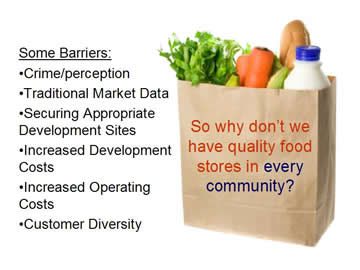
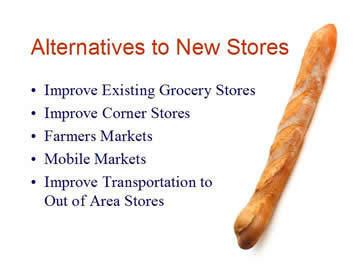
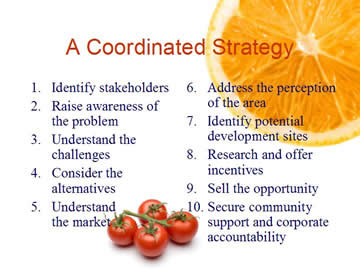
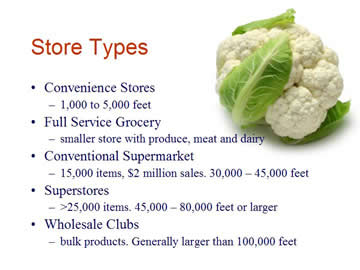
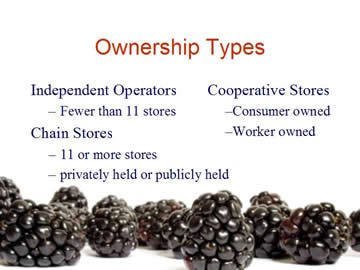
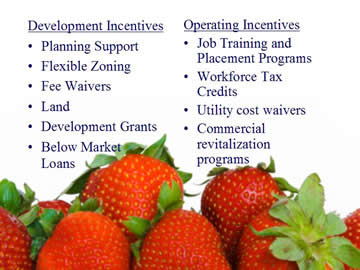
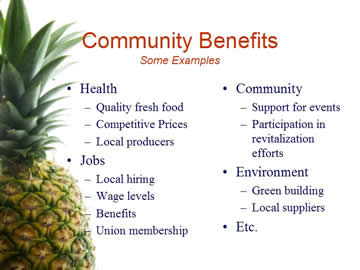
<P class=style1>This one-day workshop/discussion brought together local government staff, community advocates, economic development practitioners, and others who are working to bring healthy food retailers to underserved, low-income, urban, or rural communities. <br />
<BR><br />
The event provided an overview of the many obstacles that make new store development challenging and highlighted some of the emerging best practices that have made new stores possible in previously underserved areas. The emphasis of the event was on discussion of the real world challenges that participants are facing and potential strategies to overcome them.</P><br />
<u><strong><br />
Presenters Included: </strong></u><br />
<strong>Scott Whitney, Real Estate Director, Fresh and Easy Markets</strong><br />
British retailer Tesco is opening a new chain of grocery stores in America with a small format well suited to urban neighborhood sites. Among their initial California locations are several in lower income communities.</p>

<p><strong>Yael Lehmann, Executive Director, The Food Trust</strong><br />
TFT has led a concerted effort to bring grocery stores back to underserved communities throughout Pennsylvania. TFT has led high profile research into the need for stores which helped to convince the state to invest $20 million into a fund to finance new store development and support for existing independent grocers. </p>

<p><strong>Ertharin Cousin, LaVelle Cousin Issues Management </strong><br />
Ms. Cousin is a former senior vice president of public affairs at Albertson’s who now consults with national retailers on a variety of issues including bringing food stores to lower-income communities.</p>

<p><strong>Francis Spencer, Assistant Commissioner, Retail Chicago</strong><br />
Retail Chicago is a program of the City of Chicago that provides a comprehensive set of services designed to assist retailers in opening new stores in Chicago’s underserved neighborhoods. The program has successfully attracted several new supermarkets to Chicago’s lower-income neighborhoods. </p>

<p><strong>Michael Levine, Local Initiatives Support Corporation</strong><br />
In 1994 LISC created a private equity fund called The Retail Initiative to finance new retail centers in low-income urban neighborhoods that are anchored by supermarkets. LISC recently closed the fund after facing some significant challenges, but in the process learned important lessons that can inform other food store financing efforts. </p>

<p><strong>Gwendolyn Flynn, Los Angeles Community Health Councils</strong><br />
Community Health Councils, a nonprofit health promotion and health policy advocacy organization based in South Los Angeles, has engaged in a wide range of efforts to improve local access to healthy food. These efforts have included neighborhood assessments, conversations, and meetings with a wide range of stakeholders, and policy advocacy efforts.</p>

<p><strong>Introductory Powerpoint:</strong><br />
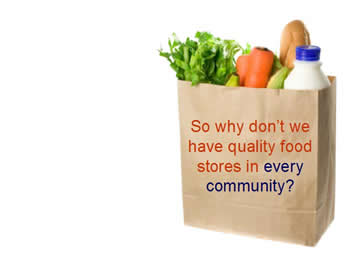
<img alt="SM_Slide1.jpg" src="http://www.rjacobus.com/resources/archives/SM_Slide1.jpg" width="360" height="270" /></p>

<p><img alt="SM_Slide2.jpg" src="http://www.rjacobus.com/resources/archives/SM_Slide2.jpg" width="360" height="270" /></p>

<p><img alt="SM_Slide3.jpg" src="http://www.rjacobus.com/resources/archives/SM_Slide3.jpg" width="360" height="270" /></p>

<p><img alt="SM_Slide9.jpg" src="http://www.rjacobus.com/resources/archives/SM_Slide4.jpg" width="360" height="270" /></p>

<p><img alt="SM_Slide9.jpg" src="http://www.rjacobus.com/resources/archives/SM_Slide5.jpg" width="360" height="270" /></p>

<p><img alt="SM_Slide9.jpg" src="http://www.rjacobus.com/resources/archives/SM_Slide6.jpg" width="360" height="270" /></p>

<p><img alt="SM_Slide9.jpg" src="http://www.rjacobus.com/resources/archives/SM_Slide7.jpg" width="360" height="270" /></p>

<p><img alt="SM_Slide9.jpg" src="http://www.rjacobus.com/resources/archives/SM_Slide8.jpg" width="360" height="270" /></p>

<p><img alt="SM_Slide9.jpg" src="http://www.rjacobus.com/resources/archives/SM_Slide9.jpg" width="360" height="270" /></p>]]>

</content>
</entry>
<entry>
<title>Inclusionary Housing Production Study</title>
<link rel="alternate" type="text/html" href="http://www.rjacobus.com/resources/archives/homeownership/000627.html" />
<modified>2007-09-15T22:52:27Z</modified>
<issued>2007-09-15T22:52:10Z</issued>
<id>tag:www.rjacobus.com,2007:/resources/5.627</id>
<created>2007-09-15T22:52:10Z</created>
<summary type="text/plain">Affordable By Choice:Trends in California Inclusionary Housing Programs was commissioned by the Nonprofit Housing Association of Northern California, The California Coalition for Rural Housing, The San Diego Housing Federation and the Sacramento Housing Alliance.  The report details the findings of a statewide survey of local government agencies that have adopted inclusionary housing policies. </summary>
<author>
<name>Rick Jacobus</name>

<email>Rick@rjacobus.com</email>
</author>
<dc:subject>Homeownership</dc:subject>
<content type="text/html" mode="escaped" xml:lang="en" xml:base="http://www.rjacobus.com/resources/">
<![CDATA[<p><img alt="Document Cover" src="http://www.rjacobus.com/images/icons/nphinclusionary07.jpg" align="left" hspace="5" vspace="5" />Written By Rick Jacobus and Maureen Hickey.</p>

<p><em>Affordable By Choice:Trends in California Inclusionary Housing Programs</em> was commissioned by the Nonprofit Housing Association of Northern California, The California Coalition for Rural Housing, The San Diego Housing Federation and the Sacramento Housing Alliance.  The report details the findings of a statewide survey of local government agencies that have adopted inclusionary housing policies.  Key findings include:</p>

<p>* Nearly one-third of California jurisdictions have inclusionary programs<br />
* More then 80,000 Californians have housing through inclusionary programs<br />
* Most inclusionary housing in integrated within market rate developments<br />
* Inclusionary housing provides shelter for those most in need<br />
* Lower-income households are best served through partnerships</p>

<p>Click here to download an <a href="http://www.rjacobus.com/resources/archives/NPHInclusionaryReport.pdf">exceprt of the report</a>. </p>

<p>Complete copies of the report can be purchased from the <a href="http://www.nonprofithousing.org">Nonprofit Housing Association of Northern California</a> for $50.</p>]]>

</content>
</entry>
<entry>
<title>Understanding Subsidy Retention</title>
<link rel="alternate" type="text/html" href="http://www.rjacobus.com/resources/archives/homeownership/000625.html" />
<modified>2007-09-15T23:01:55Z</modified>
<issued>2007-09-15T00:53:19Z</issued>
<id>tag:www.rjacobus.com,2007:/resources/5.625</id>
<created>2007-09-15T00:53:19Z</created>
<summary type="text/plain"> This animated presentation was designed to help policymakers understand the economics of permanently affordable homeownership. The key to understanding the growing homeownership affordability challenge is the relative rates of change of housing prices and incomes.  I found that this idea was difficult to explain verbally but was easy for people to understand with the help of simple drawings. 
</summary>
<author>
<name>Rick Jacobus</name>

<email>Rick@rjacobus.com</email>
</author>
<dc:subject>Homeownership</dc:subject>
<content type="text/html" mode="escaped" xml:lang="en" xml:base="http://www.rjacobus.com/resources/">
<![CDATA[<p>I created this interactive tutorial on the economics of permanently affordable housing after trying to explain these concepts to small groups with static PowerPoint slides.  The key to understanding the growing homeownership affordability challenge is the relative rates of change of housing prices and incomes.  I found that this idea was difficult to explain verbally but was easy for people to understand with the help of simple drawings.  To create the tutorial, I had to not only create the images and write the accompanying text but build a complex user interface to allow people to control the flow of the presentation and skip forward and backwards.  </p>

<p>The presentation has proven extremely popular and has been shown by myself and a number of other advocates to thousands of people at a series of housing and urban development conferences.  The latest version includes an imbedded voice narration.  The presentation can also be run without the audio with either full text narration on screen or with bulleted text for live presentations to groups. </p>

<p><br />
<object classid="clsid:d27cdb6e-ae6d-11cf-96b8-444553540000" codebase="http://download.macromedia.com/pub/shockwave/cabs/flash/swflash.cab#version=7,0,0,0" width="470" height="376" id="ResumeHolder" align="middle"><br />
<param name="allowScriptAccess" value="sameDomain" /><br />
<param name="movie" value="http://www.burlingtonassociates.com/SubsidyRetention1.6BA.swf" /><br />
<param name="quality" value="high" /><br />
<param name="bgcolor" value="#ffffff" /><br />
<embed src="http://www.burlingtonassociates.com/SubsidyRetention1.6BA.swf" quality="high" bgcolor="#ffffff" width="470" height="376" name="ResumeHolder" align="middle" allowScriptAccess="sameDomain" type="application/x-shockwave-flash" pluginspage="http://www.macromedia.com/go/getflashplayer" /><br />
</object><br />
	  <br />
<a href="http://www.burlingtonassociates.com/SubsidyRetention1.6.BA.Txt.html">View Full Screen</a><br />
<a href="http://www.burlingtonassociates.com/SubsidyRetention1.6.BA.Talk.html">View with Voice Narration</a></p>

<p><br />
This animation is included on Burlington Associates Starting a CLT Multimedia Kit.  <em>The CD version can be run from a laptop without an internet connection. </em><br />
<a href="http://www.lulu.com/BurlingtonAssociates"TARGET="_blank"> <br />
<img alt="CD.bmp" src="http://www.burlingtonassociates.com/resources/archives/CD.bmp" width="139" height="142" /></a></p>

<p><a href="http://www.lulu.com/burlingtonassociates" Target="_blank">Click here to order the disk.</a></p>]]>

</content>
</entry>
<entry>
<title>Commercial Revitalization Planning Guide</title>
<link rel="alternate" type="text/html" href="http://www.rjacobus.com/resources/archives/commercial_revitalization/000623.html" />
<modified>2007-09-15T22:50:31Z</modified>
<issued>2007-09-09T06:03:02Z</issued>
<id>tag:www.rjacobus.com,2007:/resources/5.623</id>
<created>2007-09-09T06:03:02Z</created>
<summary type="text/plain">This hands on guidebook is filled with detailed direction that will provide practitioners with a starting point for organizing comprehensive commercial district revitalization efforts. It takes the reader through each stage of revitalization from planning, research, and visioning to understanding the potential of the community, analyzing the business mix, marketing the assets, and implementing the work plan. The planning guide also provides a set of practical tools to assist in implementation.</summary>
<author>
<name>Rick Jacobus</name>

<email>Rick@rjacobus.com</email>
</author>
<dc:subject>Commercial Revitalization</dc:subject>
<content type="text/html" mode="escaped" xml:lang="en" xml:base="http://www.rjacobus.com/resources/">
<![CDATA[<p>Written by: Rick Jacobus and Maureen Hickey</p>

<p>This hands on guidebook is filled with detailed direction that will provide practitioners with a starting point for organizing comprehensive commercial district revitalization efforts. It takes the reader through each stage of revitalization from planning, research, and visioning to understanding the potential of the community, analyzing the business mix, marketing the assets, and implementing the work plan. The planning guide also provides a set of practical tools to assist in implementation.</p>

<p><u>Table of Contents:</u><br />
Forward<br />
Urban Commercial Revitalization Programs<br />
Planning For Revitalization<br />
Identifying and Involving Stakeholders<br />
Developing a Community-Based Vision <br />
Compiling Building and Business Inventories <br />
Understanding Market Data<br />
Using Surveys and Interviews to Collect Local Market Data<br />
Assessing Crime and Community Safety <br />
Developing Business Attraction Goals <br />
Evaluate Streetscape Conditions<br />
Branding the District Identity <br />
Defining an Implementation Strategy<br />
Measuring Impact </p>

<p>Appendix A: Hiring a Market Analysis Consultant <br />
Appendix B: Resources <br />
References <br />
Acknowledgements </p>

<p><img alt="commercial-revitalization.jpg" src="http://www.rjacobus.com/resources/archives/commercial-revitalization.jpg" width="107" height="140"  /> <br />
<a href="http://stores.lulu.com/cmas">Order a hard copy of this book </a>- $24.95<br />
<a href="http://stores.lulu.com/cmas">Order the Companion CD-Rom</a> - 9.95</p>

<p><a href="http://www.rjacobus.com/resources/archives/Survey%20Chapter.pdf">Download a sample chapter</a></p>]]>

</content>
</entry>
<entry>
<title>Joint Ventures with For-Profit Developers. A Guide for Community Development Corporations</title>
<link rel="alternate" type="text/html" href="http://www.rjacobus.com/resources/archives/commercial_development/000622.html" />
<modified>2007-09-15T23:23:00Z</modified>
<issued>2007-09-09T05:37:58Z</issued>
<id>tag:www.rjacobus.com,2007:/resources/5.622</id>
<created>2007-09-09T05:37:58Z</created>
<summary type="text/plain">
Joint ventures between community development corporations and for-profit partners present tremendous opportunities for CDC to build their skills and complete projects that are larger in scale and/or beyond their core competencies. However, there are a host of business issues raised by the prospect of a CDC co-owning or working closely with a for-profit on a project. This guide is designed to assist CDCs in becoming educated consumers as they think about, plan and become partners in joint ventures.</summary>
<author>
<name>Rick Jacobus</name>

<email>Rick@rjacobus.com</email>
</author>
<dc:subject>Commercial Development</dc:subject>
<content type="text/html" mode="escaped" xml:lang="en" xml:base="http://www.rjacobus.com/resources/">
<![CDATA[<p><img alt="joint-ventures.jpg" src="http://www.rjacobus.com/images/icons/JVCover.jpg" align="left" hspace="5" vspace="5" /><br />
Written by Greg Maher, Rick Jacobus, Maegan Winning and Judy Turnock.<br></p>

<p>This guide is designed to assist CDCs in becoming educated consumers as they think about, plan and become partners in joint ventures with for-profit developers.</p>

<p>Joint ventures between a community development corporation ("CDC") and a for-profit partner present tremendous opportunities for a CDC to build its skills and complete projects that are larger in scale and/or beyond its core competencies. However, there are a host of business issues raised by the prospect of a CDC co-owning or working closely with a for-profit on a project. Many issues need to be carefully negotiated for the CDC to protect its financial integrity and credibility. Based on Greg Maher's 2005 memo, this guide is structured to assist CDCs in becoming educated consumers as they think about, plan and become partners in joint ventures with for-profit developers.</p>

<p><a href="http://www.rjacobus.com/resources/archives/file_joint_ventures_guide-New%20Cover.pdf">Download PDF file</a></p>]]>

</content>
</entry>
<entry>
<title>CA League of Cities Conference</title>
<link rel="alternate" type="text/html" href="http://www.rjacobus.com/resources/archives/workshops/000621.html" />
<modified>2007-09-05T21:03:10Z</modified>
<issued>2007-09-05T20:26:50Z</issued>
<id>tag:www.rjacobus.com,2007:/resources/5.621</id>
<created>2007-09-05T20:26:50Z</created>
<summary type="text/plain">The Hidden Pros and Cons of Affordable Homeownership Programs
September 6th, 2007</summary>
<author>
<name>Rick Jacobus</name>

<email>Rick@rjacobus.com</email>
</author>
<dc:subject>Workshops</dc:subject>
<content type="text/html" mode="escaped" xml:lang="en" xml:base="http://www.rjacobus.com/resources/">
<![CDATA[<p>The Hidden Pros and Cons of Affordable Homeownership Programs<br />
September 6th, 2007</p>

<p>Panelists:<br />
Kara Douglas, Affordable Housing Programs Manager, Contra Costa County<br />
Rick Jacobus, Community Economic Development Consultant, Burlington Associates<br />
Juliet E. Cox, Attorney, Goldfarb & Lipman LLP</p>

<p><br />
Handouts<br />
Presentation Outline<br />
<a href="http://www.rjacobus.com/resources/archives/Occupancy%20letter.doc">Contra Costa Occupancy Letter</a><br />
<a href="http://www.rjacobus.com/resources/archives/Hm%20owner%20Declaration%20Form.doc">Contra Costa Owner Declaration</a></p>

<p>Additional Resources:<br />
<a href="http://www.nhc.org/pdf/chp_se_strategies_0407.pdf">Preservation of Affordable Homeownership: A Continuum of Strategies </a>by Rick Jacobus for the Center for Housing Policy</p>

<p><a href="http://www.cacities.org/resource_files/24714.Ensuring%20Continued%20Affordability.pdf">Ensuring Continued Affordability in Homeownership Programs</a> by Polly Marshall and Barbara Kautz Goldfarb & Lipman LLP for the Institute for Local Government</p>

<p><br />
<object classid="clsid:d27cdb6e-ae6d-11cf-96b8-444553540000" codebase="http://download.macromedia.com/pub/shockwave/cabs/flash/swflash.cab#version=7,0,0,0" width="490" height="355"  id="slideshowproTest" align="middle"><br />
<param name="allowScriptAccess" value="sameDomain" /><br />
<param name="movie" value="http://www.rjacobus.com/resources/archives/LeagueOfCities2.swf"/><br />
<param name="quality" value="high" /><br />
<param name="bgcolor" value="#CECF9C" /><br />
<embed src="http://www.rjacobus.com/resources/archives/LeagueOfCities2.swf" quality="high" bgcolor="#CECF9C" width="490" height="355" name="SlideshowproTest" align="middle" allowScriptAccess="sameDomain" type="application/x-shockwave-flash" pluginspage="http://www.macromedia.com/go/getflashplayer" /><br />
</object><br />
<a href="http://www.rjacobus.com/resources/archives/LeagueOfCities2.swf">Open full screen</a></p>]]>

</content>
</entry>
<entry>
<title>Commercial Development Trainings</title>
<link rel="alternate" type="text/html" href="http://www.rjacobus.com/resources/archives/portfolio/000619.html" />
<modified>2007-09-15T22:53:41Z</modified>
<issued>2007-08-23T05:42:26Z</issued>
<id>tag:www.rjacobus.com,2007:/resources/5.619</id>
<created>2007-08-23T05:42:26Z</created>
<summary type="text/plain">I developed this series of day long and multi-day workshops for the Local Initiatives Support Corporation&apos;s national Center for Commercial Revitalization to help community development corporations and local governments understand the unique challanges associated with neighborhood retail development.  I have been delivering these training courses in communities around the country including: Philadelphia, Providence, Indianapolis, San Francisco, Toledo, Jacksonville, San Diego, and Cincinnati.
</summary>
<author>
<name>Rick Jacobus</name>

<email>Rick@rjacobus.com</email>
</author>
<dc:subject>Portfolio</dc:subject>
<content type="text/html" mode="escaped" xml:lang="en" xml:base="http://www.rjacobus.com/resources/">
<![CDATA[<p><object classid="clsid:d27cdb6e-ae6d-11cf-96b8-444553540000" codebase="http://download.macromedia.com/pub/shockwave/cabs/flash/swflash.cab#version=7,0,0,0" width="490" height="355"  id="slideshowproTest" align="middle"><br />
<param name="allowScriptAccess" value="sameDomain" /><br />
<param name="movie" value="http://www.rjacobus.com/slides/cdtslides/cdtraining.swf" /><br />
<param name="quality" value="high" /><br />
<param name="bgcolor" value="#CECF9C" /><br />
<embed src="http://www.rjacobus.com/slides/cdtslides/cdtraining.swf" quality="high" bgcolor="#CECF9C" width="490" height="355" name="SlideshowproTest" align="middle" allowScriptAccess="sameDomain" type="application/x-shockwave-flash" pluginspage="http://www.macromedia.com/go/getflashplayer" /><br />
</object></p>

<p><img src="http://www.rjacobus.com/images/icons/bookcdcombo.gif" align="left" hspace="5" vspace="5">I developed this series of day long and multi-day workshops for the Local Initiatives Support Corporation's national Center for Commercial Revitalization to help community development corporations and local governments understand the unique challanges associated with neighborhood retail development.  I have been delivering these training courses in communities around the country including: Philadelphia, Providence, Indianapolis, San Francisco, Toledo, Jacksonville, San Diego, and Cincinnati.</p>

<p>Workshop topics include:<br />
<blockquote>Developing a Neighborhood Retail Strategy (1 day)<br />
Commercial District Revitalization 101 (2.5 days)<br />
Introduction to Commercial Real Estate Development (2 days)<br />
Developing a Retail Leasing Strategy (1 day)<br />
Joint Ventures with Private Developers (1 day)<br />
Financing Commercial Real Estate Projects (1 day)<br />
Negotiating Commercial Leases (1 day)<br />
Evaluating Commercial Tenants (1/2 day)<br />
Commercial Property and Asset Management (1 day)<br />
Overview of Commercial Real Estate Development (2.5 hours)<br />
Overview of Commercial District Revitalization (2.5 hours)</blockquote></p>

<p><a href="http://www.rjacobus.com/resources/archives/New%20Commercial%20Workshop%20Offerings.pdf">Download flyer with detailed course descriptions</a></p>]]>

</content>
</entry>
<entry>
<title>Resale Formula Comparison Tool</title>
<link rel="alternate" type="text/html" href="http://www.rjacobus.com/resources/archives/portfolio/000444.html" />
<modified>2007-09-15T23:12:00Z</modified>
<issued>2007-08-12T23:31:40Z</issued>
<id>tag:www.rjacobus.com,2007:/resources/5.444</id>
<created>2007-08-12T23:31:40Z</created>
<summary type="text/plain"> This general purpose educational tool was designed to help community leaders understand the relative performance of different limited equity resale formulas.  So much of what sets one model apart from the other is dependant on the assumptions you make about interest rates, home price inflation and income growth.  This tool allows a side-by-side comparison between several models, and allows you to change these input assumptions and immediately see changes in the relative performance of each of the models in terms of both ongoing affordability and equity building for homeowners. </summary>
<author>
<name>Rick Jacobus</name>

<email>Rick@rjacobus.com</email>
</author>
<dc:subject>Portfolio</dc:subject>
<content type="text/html" mode="escaped" xml:lang="en" xml:base="http://www.rjacobus.com/resources/">
<![CDATA[<p><strong><a href="http://www.burlingtonassociates.com/resale/resale.html">Click here to launch the application</a></strong></p>

<p>This general purpose educational tool was designed to help community leaders understand the relative performance of different limited equity resale formulas.  So much of what sets one model apart from the other is dependant on the assumptions you make about interest rates, home price inflation and income growth.  This tool allows a side-by-side comparison between several models, and allows you to change these input assumptions and immediately see changes in the relative performance of each of the models in terms of both ongoing affordability and equity building for homeowners.  The tool also allows you to look up historical data on home prices and median incomes for every metropolitan area in the country in order to get a better feel for what appropriate assumptions might be going forward.</p>

<p>The tool compares several of the most common resale formulas including a basic AMI index, an appraisal based formula, a mortgage based formula and a shared equity loan model.  </p>

<p>The tool is intended to help policy makers to evaluate questions like:<br />
·	When housing costs are rising rapidly, which approach preserves affordability best?<br />
·	Which approach provides the greatest asset building opportunity in the face of rising interest rates?<br />
·	If incomes grow more slowly than we expect, which approaches will be most impacted?</p>

<p>You can make the analysis more relevant to your local conditions by customizing a number of background assumptions like cost of production for a new affordable unit, the level of subsidy available, and the monthly housing costs that homeowners will face. </p>]]>

</content>
</entry>
<entry>
<title>Swans Marketplace Jobs Program</title>
<link rel="alternate" type="text/html" href="http://www.rjacobus.com/resources/archives/portfolio/000441.html" />
<modified>2007-09-15T23:26:38Z</modified>
<issued>2007-08-09T01:19:34Z</issued>
<id>tag:www.rjacobus.com,2007:/resources/5.441</id>
<created>2007-08-09T01:19:34Z</created>
<summary type="text/plain"> 
This strategy document outlined clear systems through which the nonprofit developer of Oakland&apos;s Swans Marketplace would identify the job skills that the project&apos;s commercial tenants would need, communicate those needs to referral and training partners and track the results of the hiring process for the purpose of reporting to the government agencies that had supported the project. </summary>
<author>
<name>Rick Jacobus</name>

<email>Rick@rjacobus.com</email>
</author>
<dc:subject>Portfolio</dc:subject>
<content type="text/html" mode="escaped" xml:lang="en" xml:base="http://www.rjacobus.com/resources/">
<![CDATA[<p><img alt="Swans" src="http://www.rjacobus.com/images/icons/Swans Strategy_icn.jpg"/> </td><td width="70%" align="left" hspace="5" vspace="5"><br />
<a href="http://www.rjacobus.com/Portfolio/docs/SwansJobs.pdf">Download <em>PDF Document</em><br />
</a></P></p>

<p>Like many mixed-use development projects, EBALDC's Swans Marketplace relied on grants and subsidized loans from local and federal government agencies.  These subsidies were tied to the creation of quality jobs but EBALDC decided that requiring small business tenants to hire disadvantaged workers could make the project impossible to lease. The alternative strategy was to encourage targeted hiring by identifying a team of placement, training and referral organizations and insuring that their clients were the best qualified candidates for any new jobs that were created at Swans.  This strategy document outlined clear systems through which EBALDC would identify the skills that Swans employers would need, communicate those needs to referral and training partners and track the results of the hiring process for the purpose of reporting to the government agencies that had provided the subsidies.<br />
></p>]]>

</content>
</entry>
<entry>
<title>Lower San Antonio Neighborhood Plan</title>
<link rel="alternate" type="text/html" href="http://www.rjacobus.com/resources/archives/portfolio/000440.html" />
<modified>2007-09-15T22:42:20Z</modified>
<issued>2007-08-09T01:17:30Z</issued>
<id>tag:www.rjacobus.com,2007:/resources/5.440</id>
<created>2007-08-09T01:17:30Z</created>
<summary type="text/plain">
  
     
The Lower San Antonio Neighborhood plan grew out of a 2 year long community planning process involving over 1000 neighborhood residents.  I led a team of planners and community organizers in an outreach process to bring together community leaders, nonprofit organizations, and cultural institutions from the area&apos;s many different ethnic groups.  
  
</summary>
<author>
<name>Rick Jacobus</name>

<email>Rick@rjacobus.com</email>
</author>
<dc:subject>Portfolio</dc:subject>
<content type="text/html" mode="escaped" xml:lang="en" xml:base="http://www.rjacobus.com/resources/">
<![CDATA[<table width="100%"  border="0" cellspacing="0" cellpadding="5">
  <tr>
    <td width="30%"><img alt="LSA Plan" src="http://www.rjacobus.com/images/icons/newcover_ico.jpg"/> </td><td width="70%">
Oakland's Lower San Antonio District is a multi-ethnic neighborhood with a population almost evenly divided between African American, Latino and Asian American families.  Partly because of this diversity, the neighborhood has lacked the strong organizational leadership that is so present in other Oakland neighborhoods.  Historically, the area has received less than its proportional share of public investment and social services.  

<p></a></P><br />
 </td><br />
  </tr><br />
</table></p>

<p>The Lower San Antonio Neighborhood plan grew out of a 2 year long community planning process involving over 1000 neighborhood residents.  I led a team of planners and community organizers in an outreach process to bring together community leaders, nonprofit organizations, and cultural institutions from the area's many different ethnic groups.  I facilitated neighborhood planning council meetings leading to development of a final plan which outlined the area's most pressing needs, identified what individuals and organizations were already doing to confront those problems and prioritized a list of new ideas for collaborative solutions to community problems.  The plan directly led to the creation of several ongoing new multi-ethnic collaboratives including the Roosevelt Village Center youth collaborative, the EastLake Main Street Program, CIRCLES welfare to work initiative, and a neighborhood arts alliance.  The strong cooperation evidenced by the LSA Plan was an important factor in the Annie E. Casey Foundation's decision to select Lower San Antonio as one of the neighborhoods in their national Making Connections Initiative.  The Casey Foundation will invest millions of dollars in the community over a 5 to 10 year period. </p>

<p><a href="http://www.rjacobus.com/Portfolio/docs/Plan98.pdf">Download <em>PDF Document</em> </a></p>]]>

</content>
</entry>
<entry>
<title>EastLake Revitalization Plan</title>
<link rel="alternate" type="text/html" href="http://www.rjacobus.com/resources/archives/portfolio/000439.html" />
<modified>2007-09-15T22:42:57Z</modified>
<issued>2007-08-09T01:16:36Z</issued>
<id>tag:www.rjacobus.com,2007:/resources/5.439</id>
<created>2007-08-09T01:16:36Z</created>
<summary type="text/plain">
  
     
The EastLake Main Street Strategy outlined overall goals for a commercial revitalization program for Oakland&apos;s EastLake district, identified key stakeholders whose support would be essential and spelled out a 3-year workplan and budget.   
  
</summary>
<author>
<name>Rick Jacobus</name>

<email>Rick@rjacobus.com</email>
</author>
<dc:subject>Portfolio</dc:subject>
<content type="text/html" mode="escaped" xml:lang="en" xml:base="http://www.rjacobus.com/resources/">
<![CDATA[<table width="100%"  border="0" cellspacing="0" cellpadding="5">
  <tr>
    <td width="30%"><img alt="LSA Plan" src="http://www.rjacobus.com/images/icons/EastLakeLogo_icn.jpg"/> </td><td width="70%">
In the mid 1990s, Oakland's EastLake District, then known as "New Chinatown," was the site of a string of arson fires targeting Asian Groceries.  The fires were a dramatic set back for a struggling commercial district.   As Director of Neighborhood Economic Development for the East Bay Asian Local Development Corp., I oversaw the development of a revitalization strategy in the wake of the fires.  </a></P>
 </td>
  </tr>
</table>
The Strategy involved organizing a multi-ethnic merchants association, and coordination of an ongoing program of targeted business assistance, promotion of a new more inclusive image for the district (which was never predominantly Chinese), and a series of capital improvements.  The EastLake Main Street Strategy outlined overall goals of this effort, identified key stakeholders whose support would be essential and spelled out a 3-year workplan and budget.  The document led directly to multi-year funding commitments from the City of Oakland, the Local Initiatives Support Corp. and two foundations.  

<p><a href="http://www.rjacobus.com/Portfolio/docs/Mainstreet.pdf">Download PDF Document</p>]]>

</content>
</entry>

</feed>